Fully Automatic Double Wire
Chain Link Fencing Machine
Manufacture chain link mesh faster with our high-output double-wire technology.
About This Product
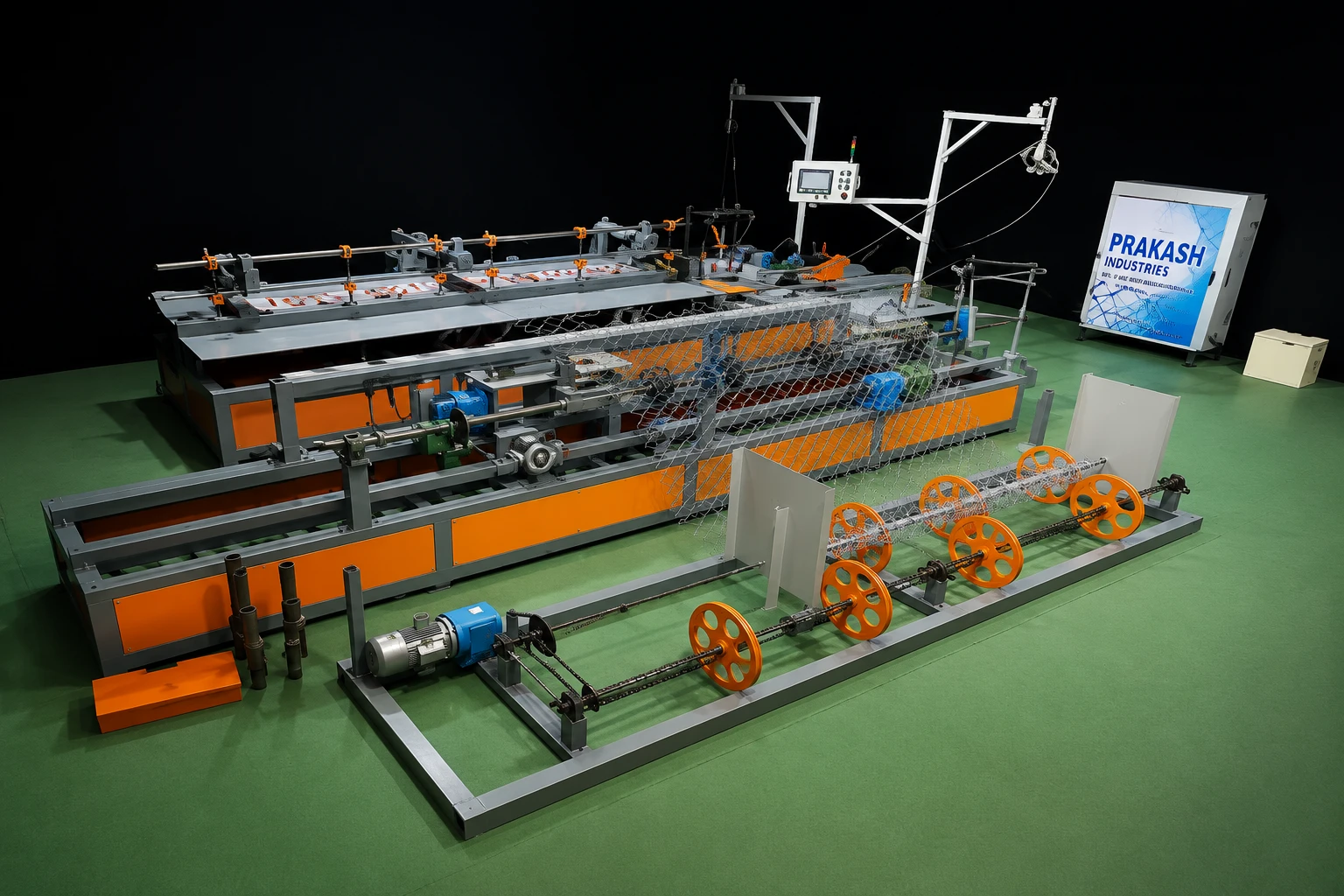
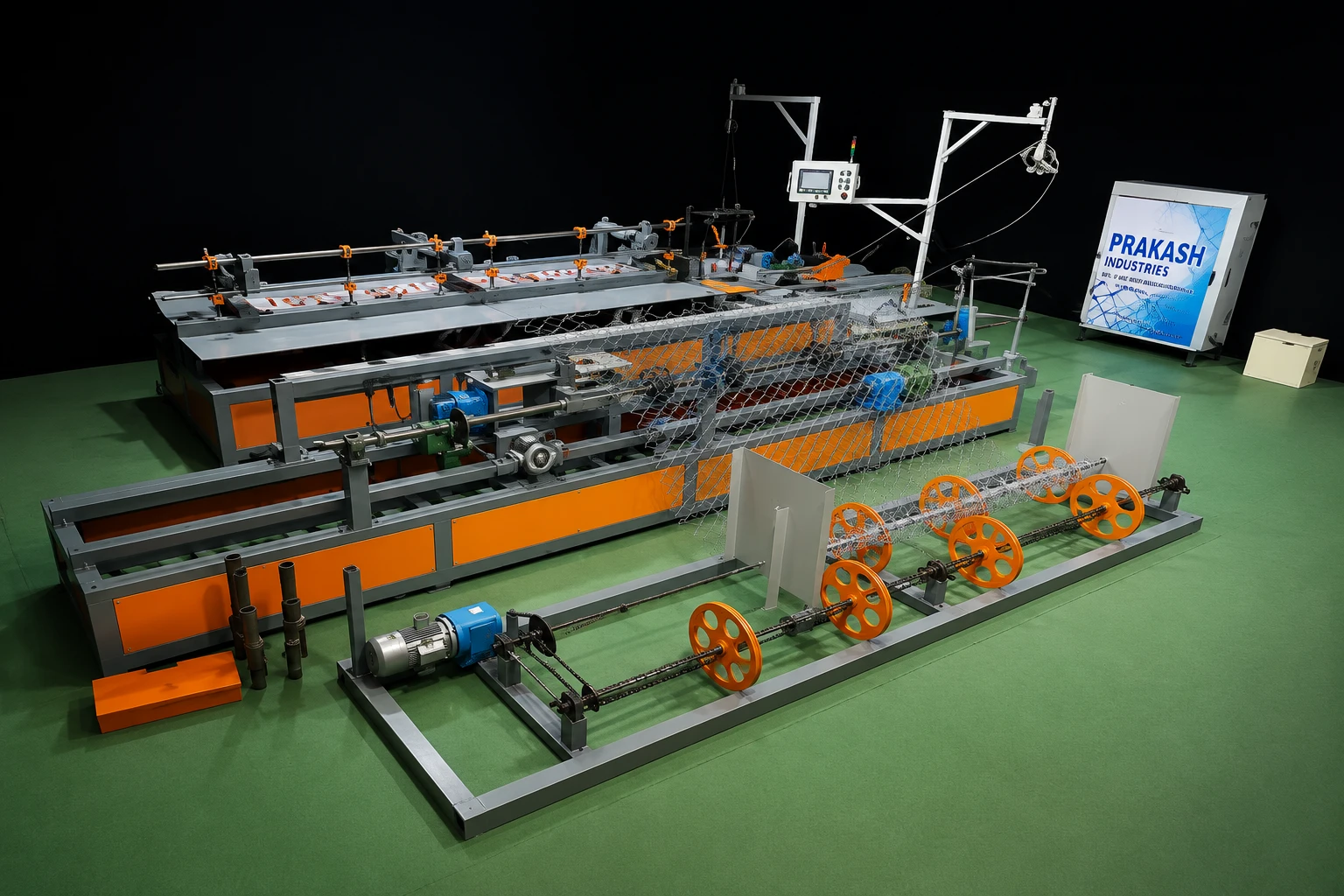
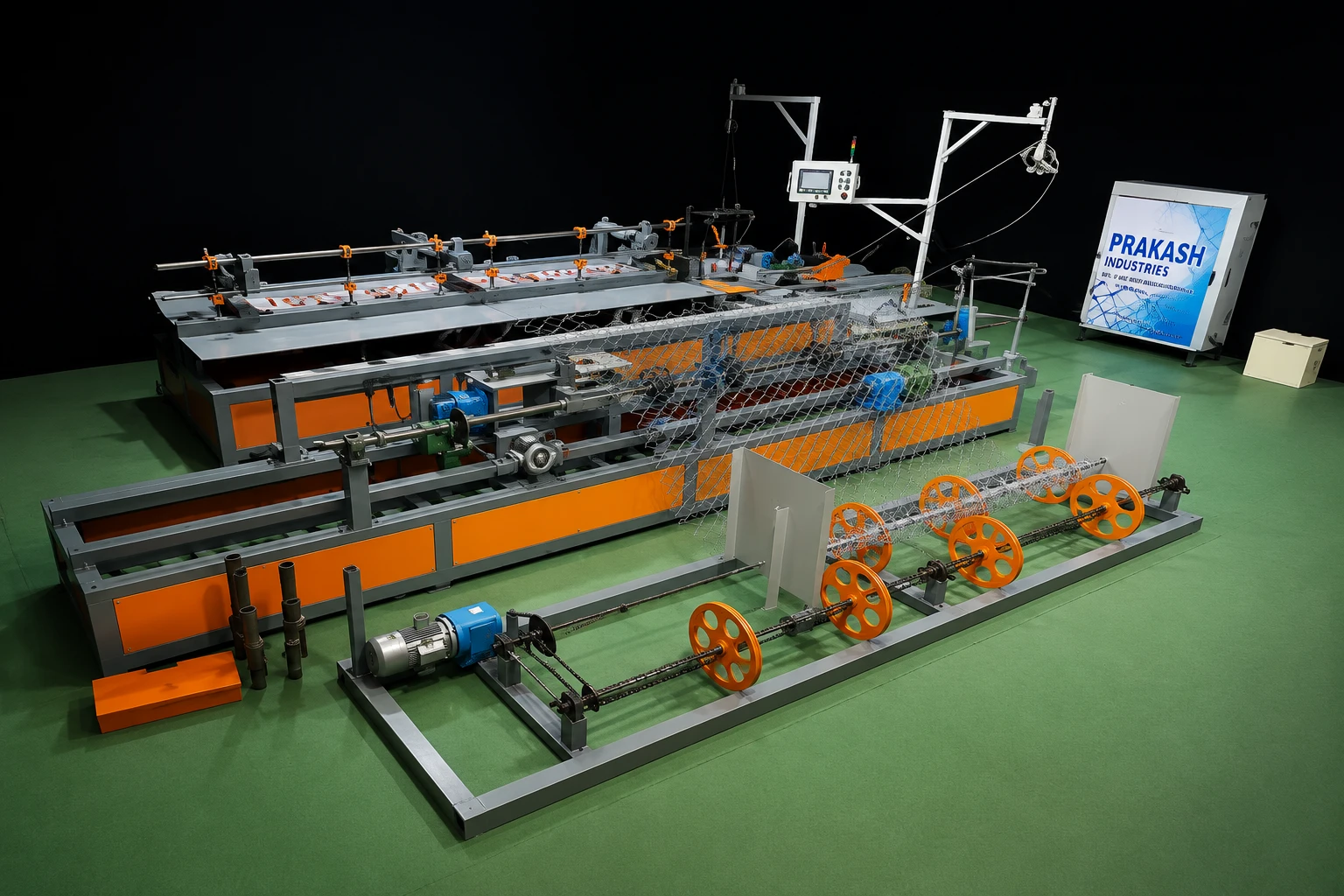
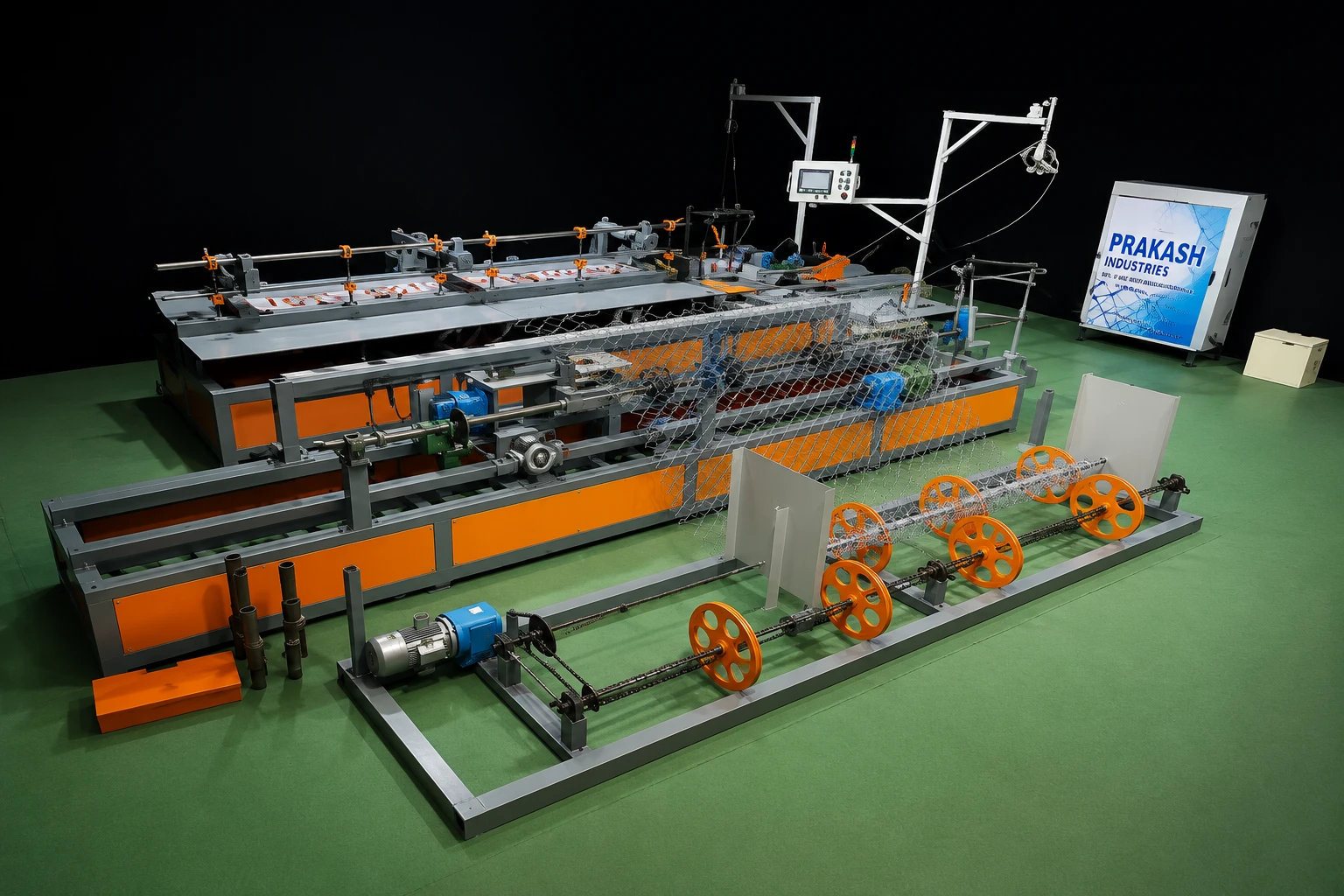
The Fully Automatic Double Wire Chain Link Fencing Machine is built for manufacturers who need production volume, not just automation. Using twin-wire, double-die weaving, it feeds and weaves two wires simultaneously through a dual-grooved die, producing GI, PVC-coated, and MS wire mesh at roughly double the rate of a standard single-wire machine — with the same Delta PLC and HMI touchscreen control that keeps operation to a single trained worker.
It's manufactured at our own ISO 9001:2015 and CE certified facility in Pune, Maharashtra, and supplied with on-site installation and operator training so it's producing sellable mesh from week one.
Get the full technical specification sheet and ex-factory price — request a quote, download the brochure, or WhatsApp our team directly for a same-day response.
 ISO 9001:2015 Certified
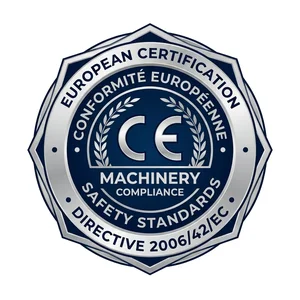 CE Certified
Fully Automatic Double Wire
Chain Link Fencing Machine
Rs. 11,00,000 + 18% GST
Ex-Factory Pune | On-Site Commissioning & Training Included
A high-capacity, dual-feed weaving system engineered to produce commercial-grade chain link fencing at near-double the speed of standard single-wire units. Driven by a Delta PLC and HMI touchscreen, this setup automates straightening, dual-groove die weaving, edge-locking, and rollout under a single operator.
140 kg/hr
High-Output Rate
2.0–4.0 mm
Wire Gauge Range
10 ft max
Weaving Width
Technical Overview & Documentation
Comprehensive system panels, mechanical feature descriptions, and downloadable brochures.
The Fully Automatic Double Wire Chain Link Fencing Machine is our highest-output model, designed specifically for fencing manufacturers who need high volume production. By weaving two strands concurrently through a custom double-grooved spiral die, this model achieves 140 kg/hr, which is double the output rate of our standard single-wire setups.
A heavy-duty main drive motor coordinates with a high-precision Delta PLC touchscreen to handle knuckling, cutting, and batch rolling of mesh panels automatically under a single operator.
- High-capacity parallel twin-wire weaving structure
- Delta PLC and HMI console coordinates both wire feeds simultaneously
- Dual heavy-duty wire payoff stand reels included
- Designed for tender-scale and distribution quantities
| Model Name | Fully Automatic Double Wire Chain Link Fencing Machine |
| Category | Fully Automatic Series |
| Output Rate | 140 kg/hr (standard GI wire, 50mm aperture) |
| Wire Range | 2.0–4.0 mm |
| Max Width | 10 ft |
| Required Operator | 1 operator |
| Detailed Specs | Scroll to Specs section below → |
- Heavy-duty PLC touchscreen controller for automated operations
- Auto knuckle bending & twisting on both sides of mesh
- Automatic length cutting sensor and roll wind spooler
- Auto-stop protection system for wire tangling or snaps
- Compatible with Galvanized (GI), PVC-coated, and Mild Steel (MS) wires
- Solid steel alloy main frame with vibration dampening
- Dual pay-off stand wire feed assembly
Prakash Industries — Machine Brochure
How the Double Wire Technology Works
A comprehensive look at the twin-wire double-die mechanics and automated manufacturing steps.
What Is Twin Wire / Double Die Technology?
"Twin wire" and "double die" describe the same core innovation: instead of one wire and one weaving die producing one strand of mesh at a time, two wires run through a die machined with two weaving grooves side by side. Both strands are woven and interlocked in the same motion, which is what allows output to scale up without simply running the machine faster (which would increase wear and reduce mesh quality). It's the same principle competitors describe as "double mold" or "double die two wires working together."
What Is a Fully Automatic Double Wire Chain Link Fencing Machine?
It's an industrial weaving machine that produces chain link (diamond mesh) fencing by feeding two wires at once through a double-grooved die, rather than the single wire a standard automatic machine uses. The result is a machine built specifically for buyers who need higher daily output — fencing manufacturers, tender suppliers, and distributors — rather than one-off or small-batch production.
The Continuous Manufacturing Sequence
Two wire spools are loaded onto a dual pay-off stand and fed simultaneously into the machine.
Both wires pass through a straightening unit to remove coil memory before weaving.
The dual-grooved die bends each wire into the diamond/rhombus pattern and interlocks them in the same motion.
Each edge of the finished mesh is knuckled or twisted (selectable) to lock the fence ends and prevent unraveling.
Once the mesh reaches the programmed length, the machine cuts automatically and rolls the finished mesh for dispatch.
The entire cycle — mesh length, weaving speed, cut points — is set and monitored from a Delta PLC with HMI touchscreen.
Key Benefits & Automated Features
Advanced double-wire technology engineered for higher productivity, precision, and long-term reliability.
| Benefit / Feature | Description |
|---|---|
|
Higher Throughput
|
Provides a stable 140 kg/hr output capacity using parallel twin-wire dual weaving, doubling the speed of standard single-wire setups. |
|
Lower Cost Per KG
|
Reduces conversion cost to ₹1.91 per kg by absorbing labor, power, and tooling wear over double the output weight. |
|
Same Operator Requirement
|
Requires only 1 trained operator to manage spool changes, rollout packaging, and program adjustments, keeping labor costs flat. |
|
Consistent Mesh Quality
|
Feeds and interlocks two wire strands through a single dual-grooved die, ensuring identical sizing and tension. |
|
Delta PLC Touchscreen Panel
|
Provides a user-friendly HMI panel to configure roll length, weaving speed profiles, and run instant loop error diagnostics. |
|
Twin-Grooved Weaving Die
|
Machined from high-grade alloy steel to bend and form two wire strands simultaneously without overlaps or friction jams. |
|
Selectable Edge Finishing
|
Automatically knuckles, twists, or combines outer nodes at both edges of the mesh to lock loops and prevent unravelling. |
|
Automatic Length Cut-off
|
Integrates physical proximity sensors that trigger instant mechanical clipping once the desired roll length is reached. |
Technical Specifications
Comprehensive data parameters covering motors, dimensions, capacity, and power draws.
| Model Name | Fully Automatic Double Wire Machine |
| Category | Fully Automatic Series |
| Automation | Fully automatic PLC-controlled dual-wire production |
| Control System | Delta PLC with HMI touchscreen interface |
| Drive System | Dual INVT frequency drive integration |
| Output Rate | 140 kg/hr (standard 3.0 mm GI wire, 50mm mesh size) |
| Wire Gauge Range | 2.0–4.0 mm |
| Max Weaving Width | 10 ft (standard; custom widths available up to 12 ft) |
| Mesh Aperture Range | 30–80 mm (adjustable via modular dies) |
| Operators Required | 1 operator |
| Connected Load | 4.0 kW (5.3 HP) |
| Typical Running Load | 3.0 kW |
| Grid Requirement | 415V Three-Phase, 50Hz electrical supply |
| Weight | Approx. 3,500 kg |
| Footprint Dimensions | 4.5m × 2.2m × 2.2m (approx. 15 ft × 7.2 ft × 7.2 ft) |
| Recommended Clearance | 6.0m × 4.5m (for wire payoffs, storage, & staging) |
| Compatible Wires | Galvanized Iron (GI), PVC-coated, Mild Steel (MS) |
| Commercial Wires | High-torque rollers process commercial-grade **Raipur wire** smoothly |
| Feed Setup | Dual heavy-duty mechanical payoff stands (800 kg capacity each) |
| Manufacturer | Prakash Industries (a unit of Prakash Fabrication Work) |
| Factory Location | Junnar Taluka Industrial Estate, Kandali, Pune, Maharashtra, India |
| Price | Rs. 11,00,000 + 18% GST (ex-factory Pune) |
| Installation Support | Complete on-site commissioning & calibration (included) |
| Operator Training | 2 days hands-on site training (included) |
| Warranty | 12 months mechanical warranty on manufacturing defects |
Industries & Applications
How the high-output double-wire line fits the unique procurement and technical specs of major industries.
Agricultural Chain Link Fencing
Agricultural fencing needs to survive years of outdoor exposure, occasional livestock impact, and minimal maintenance — GI chain link mesh is the standard answer because it combines corrosion resistance with a lower cost per metre than welded panel alternatives. For fencing manufacturers, farm and agricultural clients typically order in bulk ahead of planting or fencing-replacement seasons, which rewards suppliers who can turn around large mesh orders quickly. A double-wire machine supports this seasonal-demand pattern directly, since output can scale to meet a seasonal order spike without adding a second production line.
Highway Fencing
Highway fencing contracts are almost always large, continuous-run orders — kilometres of mesh at a single, tender-specified gauge and mesh size, with firm delivery deadlines tied to the broader construction schedule. This is the clearest volume use case for double-wire production: a supplier with double the hourly output can either commit to shorter delivery windows or take on larger single contracts than a single-wire competitor. Highway fencing typically specifies heavier-gauge GI mesh for durability under continuous weather and vibration exposure.
Railway Fencing
Similar in profile to highway fencing — long, continuous perimeter runs along rail corridors, specified to prevent trespass and track intrusion. Railway tenders often bundle multiple line-sections into a single award, meaning the winning supplier needs sustained weekly output over the contract period, not just a large one-time batch. Consistent mesh specification across the full order (a strength of PLC-controlled double-die weaving) matters here because inconsistent mesh sizing across a multi-kilometre order is a common cause of tender non-compliance flags.
Airport Security Fencing
Airport perimeter fencing sits at the intersection of security specification and civil engineering procurement — it typically requires certified manufacturing (ISO/CE), documented mesh specifications, and reliable large-volume delivery. Heavier security-grade mesh can be produced on the same double-wire machine used for standard fencing without retooling, which lets a single manufacturer serve both standard boundary and higher-security airport-grade orders from one production line.
Industrial Perimeter Fencing
Industrial and factory fencing buyers are often expanding across multiple sites simultaneously, which turns a single client relationship into a repeat, multi-site order pattern rather than a one-off purchase. Suppliers with higher hourly output are better positioned to serve this repeat-order relationship without falling behind on lead times as the client's site count grows.
Residential Fencing
Individual residential orders are smaller, but housing developers, gated communities, and municipal housing schemes aggregate many boundary-fencing orders into effectively industrial-scale volume. PVC-coated mesh is the dominant choice here for its finished appearance, and consistent colour/finish across a large housing development is easier to guarantee from a single high-output production run than from multiple smaller batches.
Sports Ground Fencing
Stadiums, courts, and playing fields need mesh that's structurally sound (ball impact, spectator safety) and visually consistent across a large enclosed area. PVC-coated mesh is standard for its appearance; large public sports facility contracts reward suppliers who can deliver a full stadium's perimeter mesh in a single consistent production run rather than multiple batches with subtle finish variation.
Solar Plant Fencing
Solar installations sit on large, flat, open sites and require full-perimeter security fencing as standard practice to prevent theft and animal intrusion into panel arrays. As India's solar capacity additions continue, each new site represents a large, single-order fencing contract — often issued as part of the broader EPC (engineering, procurement, construction) tender for the plant itself, meaning fencing suppliers who can guarantee volume and schedule reliability are positioned to win recurring solar-sector business.
Warehouse Security
Warehousing and logistics facilities require perimeter and yard security fencing sized to large industrial footprints, often across multiple distribution centres for a single logistics operator. As with industrial perimeter fencing, the repeat-order, multi-site nature of this buyer segment favours suppliers who can maintain consistent output without lead-time slippage as order volume grows.
Where Chain Link Fencing Is Used
Explore sixteen distinct boundary, safety, and security fields driving repeat orders for mesh suppliers.
Agriculture Farms
Keeps livestock contained and crops protected from stray animals at a lower cost than solid boundary walls. Easy to extend.
Poultry Farms
Fine-mesh chain link fencing keeps poultry enclosed while allowing ventilation and predator protection in sheds.
Animal Fencing (Livestock)
Contains livestock securely while remaining visually open. Offers adjustable height and mesh size flexibility.
Highway Fencing
Prevents animal and pedestrian intrusion onto highways. Withstands continuous exposure and vibration.
Border Security
Forms the base layer of perimeter border walls. Often combined with barbed wire or security layers.
Railway Projects
Fences railway track boundaries to prevent trespassing and animal intrusion along rail corridors.
Airports
Perimeter security fencing that meets standard regulations while remaining cost-effective over long boundaries.
Government Projects
Specified across defence, municipal public works, and public transit terminals for security marking.
Sports Grounds
Encloses playing fields, courts, and stadiums. PVC-coated color options offer neat landscaping appearance.
Factories
Secures factory boundaries and separates internal zones for safety, asset grouping, and access controls.
Warehouses
Cost-effective boundary yard containment for storage, cargo clearance, and distribution warehouses.
Residential Boundaries
Affordable, low-maintenance border fences for residential boundaries, private houses, and gated complexes.
Schools and Colleges
Campus security and safe play boundaries, meeting regional education boards' security standards.
Solar Plants
Large flat solar fields require boundary lines to block intruders from arrays and substations.
Industrial Areas
Dividing boundaries for multitenant industrial zones, manufacturing plots, and estate borders.
Construction Projects
Quick boundary partitions for temporary building safety, separating pedestrian lanes from worksites.
Why Choose Prakash Industries
Partner with India's pioneering manufacturer of high-performance chain link fencing machinery.
Pioneering Engineering Since 2009
Founded in 2009 by Mr. Prakash Vethekar, Prakash Industries (a unit of Prakash Fabrication Work) has grown from a local workshop in Pune to a leading global equipment supplier. We design, calibrate, and weld our machine chassis in-house under strict ISO 9001:2015 quality guidelines, ensuring structural longevity.
With 1,480+ machines installed across India and exported to more than 20 countries (including South Africa, Kenya, Saudi Arabia, Nigeria, Philippines, and UAE), we support growing regional workshops and national tender corporations alike.
Our double-wire machine runs on a Delta PLC with an HMI touchscreen. It's engineered to process commercial-grade wire feedstocks (such as Raipur wire) smoothly without loop snaps or tension failures, protecting your mechanical setup.
Global Manufacturing Credentials
-
Established2009
-
Machines Installed1,480+ Installations
-
Export Presence20+ Countries
-
Founder & Chief EngineerMr. Prakash Vethekar
-
CertificationsISO 9001:2015 & CE Certified
-
Facility LocationPune, Maharashtra, India
Comparison: Double Wire vs Single Wire Machine
Compare the technical profiles and costs of our product range to size the ideal machinery.
Double Wire vs Single Wire Machine
| Factor | Double Wire Machine (This Model) | Single Wire Machine |
|---|---|---|
| Wires woven simultaneously | 2 wires | 1 wire |
| Relative output | 140 kg/hr (Twin-wire speed) | 70–100 kg/hr (Baseline) |
| Best suited to | Tenders, bulk/repeat orders, volume distributors | Smaller batch orders, start-ups, first-time buyers |
| Machine cost | Rs. 11,00,000 + 18% GST | Rs. 8,50,000 + 18% GST |
| Operator requirement | 1 operator (PLC/HMI automated) | 1 operator |
Bottom line: choose double wire if your order volume or growth plan justifies the higher upfront machine cost through lower cost-per-kg at scale; choose single wire if you're starting out or serving smaller, irregular orders.
Automatic vs Semi-Automatic Machine
| Factor | Fully Automatic | Semi-Automatic |
|---|---|---|
| Operator involvement | Minimal — PLC/HMI touchscreen controlled | Higher — manual feeding/adjustment steps |
| Output consistency | High, program-governed uniform sizing | Variable, operator-dependent tension |
| Upfront cost | Higher (Rs. 6.5L to 11L depending on model) | Lower (Rs. 3,50,000 + GST) |
| Best suited to | Ongoing production, tenders, repeat bulk orders | Entry-level production, budget-constrained buyers |
Bottom line: semi-automatic machines suit buyers testing the market or working with tight capital budgets; fully automatic machines suit buyers who already have consistent order flow to justify the investment.
GI vs PVC Mesh
| Factor | GI (Galvanized) Mesh | PVC-Coated Mesh |
|---|---|---|
| Corrosion resistance | Good (zinc coat layer protection) | Better (additional synthetic polymer barrier) |
| Appearance | Standard silver/galvanized metallic look | Coloured, smooth visual aesthetics (green, blue, etc.) |
| Typical use | Agricultural farms, industrial boundaries, highway fencing | Residential gates, public parks, high-visibility sports fields |
| Relative cost | Lower (standard metal wire cost) | Higher (due to compound coating cost) |
Bottom line: GI mesh wins on cost and is the default for utility/security fencing; PVC-coated mesh wins where finished appearance matters, typically residential and public-facing installations.
Industry Insights & Expert Answers
An authoritative technical guide for fencing manufacturers, contractors, and industrial mesh buyers.
Q. What is a Double Wire Chain Link Fencing Machine?
A fully automatic double wire chain link fencing machine is a high-output manufacturing unit that weaves two wire strands concurrently to build interlocking diamond mesh panels. Unlike standard automatic single-wire machines that weave a single strand through one die at a time, this dual-line setup processes two spools simultaneously through a dual-grooved spiral die. This increases hourly output capacity to 140 kg/hr, making it the ideal choice for fence fabricators scaling production for industrial, highway, and airport security boundaries. The process is fully automated via integrated Delta PLC programs, requiring only one trained operator to manage wire spool changes and rollout packaging.
Q. How does Twin Wire technology work?
Twin wire or double die technology operates by feeding two wire strands simultaneously into a custom-machined spiral die. A heavy-duty motor drives the main spindle, which rotates the die to form two parallel wire spirals in a single revolution. These two formed spirals are guided and twisted into the preceding mesh section in parallel, intermeshing concurrently. This allows the machine to double its production output without increasing winding spindle speeds, which would otherwise accelerate guide wear, loop snaps, and mechanical friction. High-torque tension rollers and calibrated straightening blocks ensure that both wire feeds maintain identical speed and alignment throughout continuous multi-shift production.
Q. Where is chain link fencing used?
Chain link fencing is an incredibly versatile barrier option utilized globally for boundary protection, safety zoning, and property demarcation. Its structural flexibility and high visibility make it the standard perimeter solution for agricultural farms, poultry cages, livestock yards, and forestry perimeters. It is heavily specified in public transport and civil engineering, including highway dividers, railway track boundaries, and airport safety yards. Additionally, sports grounds, residential housing blocks, logistics warehouses, solar plant boundaries, and construction safety zones utilize galvanized iron or PVC-coated chain link mesh to establish secure, weather-resistant boundaries at a lower cost than solid walls.
Q. Why is chain link fencing important in agriculture?
In agriculture, boundary protection is critical to contain livestock and safeguard valuable cash crops from stray animals and wildlife damage. Chain link fencing is the preferred agricultural boundary option because it provides a durable, physical perimeter barrier at a fraction of the cost of solid concrete or masonry structures. The open woven mesh design allows natural airflow and light transmission, which is crucial for crops and poultry enclosures. By using galvanized iron (GI) wire with heavy zinc coating or PVC-coated wire, farm owners secure perimeters that resist humidity, soil chemicals, and outdoor exposure, maintaining structural durability for over 15 years.
Q. Why do government projects use chain link fencing?
Government infrastructure projects — including national highway fencing, railway corridors, defense borders, and municipal spaces — specify chain link fencing because of its standardized parameters and predictable service life. Public tenders require rigid compliance with zinc coating weights, wire gauges (ranging from 2.0 to 4.0 mm), and tensile strength standards. Chain link mesh meets these criteria at a predictable procurement cost. Using automated PLC-controlled weaving machinery, manufacturers deliver uniform mesh sizes and consistent node knuckling, which is mandatory to clear civil engineering site inspections. The fast on-site installation and low maintenance further support municipal budget allocation.
Q. Which industries need chain link fencing machines?
Chain link fencing machines are essential capital equipment for wire product manufacturers, jali factories, industrial fence fabricators, and boundary construction contractors. Large-scale fence suppliers and tender contractors utilize high-capacity double-wire lines to fulfill high-volume orders for highway guardrails and solar farm borders on tight delivery schedules. Existing wire drawing and nail manufacturing plants add chain link weaving lines to diversify their industrial range using their current wire supply networks. Additionally, export-focused supply companies install high-output automatic lines to manufacture consistent, calibrated mesh rolls that meet international export specifications for global markets.
Q. Double Wire vs Single Wire Machine.
The primary difference between a double wire machine and a single wire machine is hourly output and capital allocation efficiency. A standard single-wire automatic machine processes one strand of wire, yielding 70–100 kg/hr, which is ideal for regional workshops or smaller batch orders. The double-wire machine draws two spools simultaneously to yield 140 kg/hr, making it suited for large government tenders, high-capacity distributors, and export hubs. Although the double-wire machine carries a higher upfront price (Rs. 11,00,000 + GST compared to Rs. 8,50,000 for single-wire), it absorbs operator labor and electricity costs per kg far better, maximizing profit margins at scale.
Q. What factors affect chain link fence production cost?
The primary driver of chain link fence production cost is the raw wire cost (representing over 90% of the material share). Beyond metal stock, conversion costs are determined by utility rates (power consumption per hour), operator labor wages, and machine amortization. Standard automatic machines require a trained operator and draw continuous power. High-output double-wire machinery optimizes these inputs by yielding 140 kg/hr, reducing conversion costs to approximately ₹1.91 per kg (including electricity at ₹0.17, labor at ₹0.51, consumables/tooling wear at ₹0.50, and machine depreciation at ₹0.73), which is significantly lower than manual or semi-automatic alternatives.
Q. Which wire types can be used?
Industrial chain link fencing machines process three primary raw wire materials: Hot-Dip Galvanized Iron (GI) wire, PVC-coated wire, and Mild Steel (MS) black wire. Galvanized wire provides excellent outdoor weather resistance due to its protective zinc coating and is the default for agricultural and utility boundary fencing. PVC-coated wire features a synthetic polymer sleeve over a metal core, offering premium corrosion protection and custom colors for public playgrounds and residential spaces. High-performance machines with hardened alloy steel feed guides and high-torque rollers also run commercial-grade wire (like Raipur wire) smoothly without causing tangles or loops.
Q. Why are PLC and HMI important in modern chain link machines?
Modern automatic chain link fencing machines utilize a programmable logic controller (PLC) and a Human-Machine Interface (HMI) touchscreen to automate the full production line. The PLC acts as the machine's brain, coordinating the wire feed rate, spindle rotation speed, cutter sensor, edge knuckler, and roller pins. The operator inputs batch dimensions, weave speed, and target lengths directly into the HMI screen. If a wire tangles or snaps, sensors instantly alert the PLC, halting the line to prevent die damage. This automation reduces labor requirements to a single operator while guaranteeing consistent mesh sizes.
Q. How do I choose the right chain link fencing machine?
Choosing the right machine requires matching your current and near-term order volumes against machine yield and capital budget. Start-up workshops or rural businesses serving local agricultural clients often choose manual or semi-automatic setups (yielding 250 kg per shift) due to lower initial investment. Expanding manufacturers and tender contractors bidding on government highways, solar parks, or railway corridors require fully automatic lines. For standard production, a single-wire automatic machine (70-100 kg/hr) is optimal; for high-volume export orders or tender quantities, a double-wire machine (140 kg/hr) offers the best payback through low conversion cost.
Frequently Asked Questions
Comprehensive operational, commercial, and technical answers about the double-wire machine.
It is an industrial weaving machine that feeds two wires simultaneously through a dual-grooved die, forming and interlocking two spirals at once. It automatically controls wire feeding, straightening, weaving, edge-knuckling, cutting, and mesh rolling via a PLC system, achieving roughly double the output of a single-wire machine.
A single-wire machine processes one strand of wire through a single die, yielding 70-100 kg/hr. The double-wire machine uses a dual payoff stand to feed two wires simultaneously into a double-grooved spiral die. This produces two interlocking strands in the same rotational cycle, yielding 140 kg/hr while keeping floor space and labor requirements identical.
The machine is rated for a stable production output of 140 kg/hr when weaving standard GI wire at a 3.0 mm gauge and 50 mm aperture. Variations in wire gauge (2.0–4.0 mm) and mesh size (30–80 mm) will affect the final hourly weight.
The conversion cost is approximately ₹1.91 per kg (which includes power draw at ₹0.17, operator labor at ₹0.51, consumables/maintenance at ₹0.50, and machine depreciation at ₹0.73). Combined with standard raw GI wire priced at ₹65.00/kg, the total production cost is roughly ₹66.91 per kg.
The machine requires a standard 415V Three-Phase electrical grid hookup. It has a connected load rating of 4.0 kW (5.3 HP) and a typical running draw of 3.0 kW during active dual weaving.
Only 1 operator is required to run the line. The Delta PLC coordinates the feeding, weaving, knuckling, cutting, and rolling automatically, so the operator only needs to load spools, set program parameters, and package finished rolls.
The base machine footprint is 4.5m × 2.2m × 2.2m. However, we recommend a total operating floor clearance of **6.0m × 4.5m** (20 ft × 15 ft) to comfortably fit the dual wire payoff stands behind the machine and stage raw wire coils and finished rolls.
The machine handles Hot-Dip Galvanized (GI) wire, PVC-Coated GI wire, and Mild Steel (MS) black wire. It is also designed with custom hardened alloy steel guides to run lower-grade commercial wires smoothly.
It produces mesh aperture sizes ranging from 30 mm to 80 mm. Sizing adjustments are made by swapping the forming tube and dual-spiral weaving dies (dies are built to order in-house).
The ex-factory price is Rs. 11,00,000 + 18% GST (FOB Pune). This price includes on-site installation, commissioning support, and operator training.
Yes, standard on-site installation and commissioning are included. Our senior technicians will visit your factory site to assemble, level, align, and perform calibration test runs using your wire feedstock.
Yes, we provide 2 days of hands-on operator training on-site. We train your worker on PLC menu options, aperture die changing, wire threading, safety triggers, and rolling/cut-off calibrations.
Prakash Industries is an **ISO 9001:2015 certified manufacturer** and all fully automatic models carry official **CE certification**, ensuring structural safety, quality welding, and high-performance calibration.
Every machine is fabricated, assembled, and calibrated in our manufacturing facility located in **Kandali, Pune, Maharashtra, India** (Junnar Industrial Estate).
Yes, absolutely. Government road, rail, and airport fencing tenders dictate strict timeline delivery and mesh gauge consistency. The 140 kg/hr high throughput, certified ISO/CE build, and PLC-governed precision make this machine the ideal solution for bidding contractors.
Fences produced are supplied to agricultural farms, poultry farms, highways, railways, airport boundaries, solar plant fields, border perimeters, housing societies, sports stadiums, industrial zones, and construction yards.
Yes, solar plants require full boundary protection over vast acreage to prevent theft of copper cables and PV panel damage. Chain link fencing provides the lowest cost per linear meter of security compared to steel panels or masonry walls.
GI mesh uses zinc-coated iron wire and offers excellent structural durability and rust protection. PVC-coated mesh has an additional colored synthetic polymer sheath over the galvanized core, offering maximum corrosion protection and styled colors for public spaces.
Yes. The machine handles both wire types. The die, feed rollers, and cutting processes remain exactly the same; the operator only needs to set appropriate feed tension profiles in the HMI depending on the outer sleeve thickness of the PVC-coated wire.
Standard lead time is 15 to 20 days from the booking date (after clearing the 20% advance booking payment). Factory assembly, testing, and transport staging take about 2 weeks, followed by on-site technician deployment.
Yes. We offer a 12-month warranty on mechanical components. Standard parts (winding dies, cut-off blades, straightening rollers) are manufactured in-house in Pune and kept in stock for immediate overnight dispatch. Post-warranty Annual Maintenance Contracts (AMC) are also available.
Yes. Many local suppliers purchase commercial-grade wire (commonly referred to as **Raipur wire** in India) because of lower raw material cost. Our machine is constructed with heavy-duty feed guides and high-torque rollers that can smoothly process commercial-grade wires without frequent tangling, breaks, or guide wear.
A fully automatic machine performs the complete cycle (straightening, weaving, knuckling, cutting, rolling) without operator physical contact, requiring just 1 operator to oversee the HMI. A semi-automatic machine requires manual wire cutting, manual knuckling/bending steps, and manual roll removal, demanding higher labor time and causing variable output consistency.
Yes, absolutely. We host live, fully functional machine demonstrations at our primary factory and demo unit located in **Kandali, Pune, Maharashtra**. You can bring your own wire feedstock to see the twin-weaving speeds and knuckler calibrations firsthand. Contact our sales department to book a demo slot.
Buyer Guides
Explore buying guides, machine comparisons, cost calculators, and expert resources to make the right investment decision.
How to Choose a Chain Link Fencing Machine
Match the machine to your actual order profile, not your aspirational one: if most of your orders are small and irregular, a semi-automatic or single-wire machine may have a better payback period; if you're regularly quoting tenders or repeat bulk orders, double-wire output pays for itself through lower cost-per-kg at scale.
How Much Production Is Needed
Estimate your required kg/hr by working backward from your largest realistic monthly order and your available production hours per month — a machine sized to your peak demand avoids both under-capacity (missed deadlines) and over-capacity (idle machine time).
Layout & Infrastructure Checklist
- Power load: 4.0 kW connected, 3.0 kW running load (415V Three-Phase).
- Physical footprint: 4.5m × 2.2m × 2.2m. Weight: ~3,500 kg.
- Workspace clearance: 6.0m × 4.5m (approx. 20 ft × 15 ft) workspace suggested.
- Labor required: 1 trained operator (governed via Delta PLC/HMI touchscreen).
Cost Per Kg (Worked Conversion Calculator)
Based on a 140 kg/hr running output and standard wholesale metal costs (GI wire at ₹65.00/kg):
| Cost Input | Basis | Cost/Kg |
|---|---|---|
| Raw Wire | GI Wire Wholesale Cost | ₹65.00 |
| Electricity | 3.0 kW draw @ ₹8.00 / 140 kg | ₹0.17 |
| Labor Cost | 1 Operator @ ₹72/hr / 140 kg | ₹0.51 |
| Consumables | Dies, blades, and oil wear | ₹0.50 |
| Amortization | Machine cost spread over 10 yrs | ₹0.73 |
| Total Cost | Conversion Cost = ₹1.91 | ₹66.91 |
Note: The high hourly yield of 140 kg/hr absorbs labor and power overheads far better than single-wire lines, reducing conversion costs to under ₹2.00 per kg.
Industry Insights & Expert Answers
Get expert answers to common questions about chain link fencing machines, applications, production, and industry use cases.
A double wire chain link machine is a fully automatic fencing machine that weaves two wires simultaneously through a double-grooved die, producing chain link (diamond mesh) fencing at roughly double the hourly output (140 kg/hr) of a standard single-wire machine, using PLC and HMI touchscreen control.
Evaluating a chain link fencing machine in India comes down to four factors: certified manufacturing (ISO 9001:2015/CE), documented and consistent output at your required wire gauge, transparent ex-factory pricing, and included installation/operator training. A fully automatic double wire machine adds higher throughput for buyers serving tenders or bulk repeat orders.
Agricultural chain link fencing machines produce GI wire mesh suited to outdoor, low-maintenance boundary and livestock fencing. A double-wire machine allows agricultural fencing suppliers to meet seasonal bulk-order demand without a second production line.
Government fencing tenders — highway, railway, airport, and municipal — typically require ISO/CE certified manufacturing, consistent documented mesh specification, and reliable large-volume delivery, all of which a PLC-controlled double wire machine is built to support.
Highway fencing contracts require continuous, large-volume mesh production at a fixed specification and delivery timeline. A double wire machine's higher hourly output (140 kg/hr) directly supports the volume and schedule demands of highway tender contracts.
Solar plant sites require full-perimeter security fencing as standard practice, typically issued as a single large order within the plant's broader construction tender — a use case that favours fencing suppliers with higher, more reliable production output.
Prakash Industries manufactures fully automatic double wire chain link fencing machines at its ISO 9001:2015 and CE certified facility in Pune, Maharashtra, with on-site installation and operator training included in the ex-factory price.
Explore Related Models
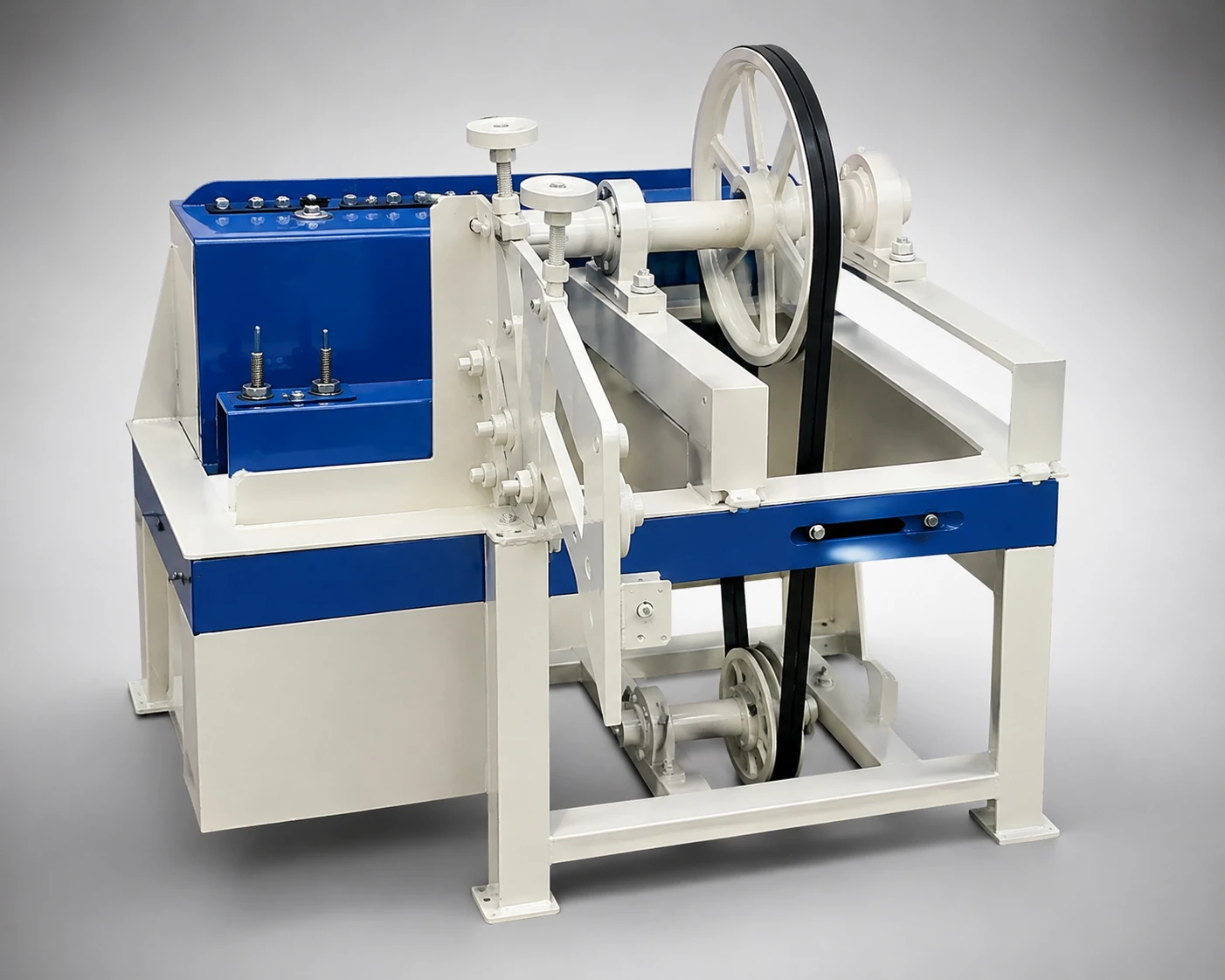
Manual Chain Link Fencing Machine
Heavy-duty cast iron body. Simple winding rod assembly. Manually operated or with 1 HP motor attachment. Zero complex electrical circuits. Perfect for rural startups.
Rs. 60,000 + 18% GST
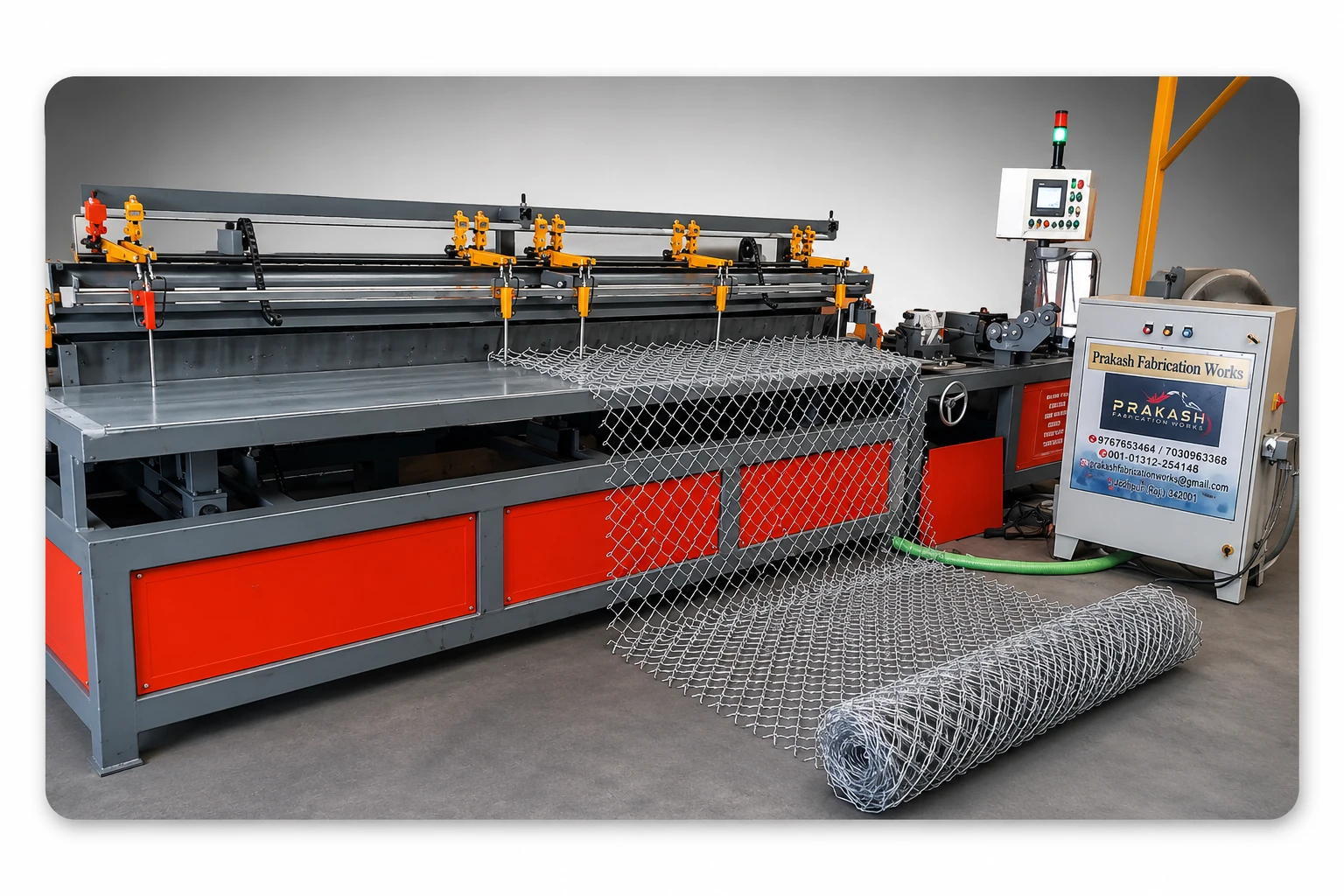
Semi Automatic Cutting + Viewing Chain Link Fencing Machine
Synchronized cutter and viewing belt. Continuous automatic winding with Hindustan 1440 RPM motors. Single operator console.
Rs. 3,50,000 + 18% GST
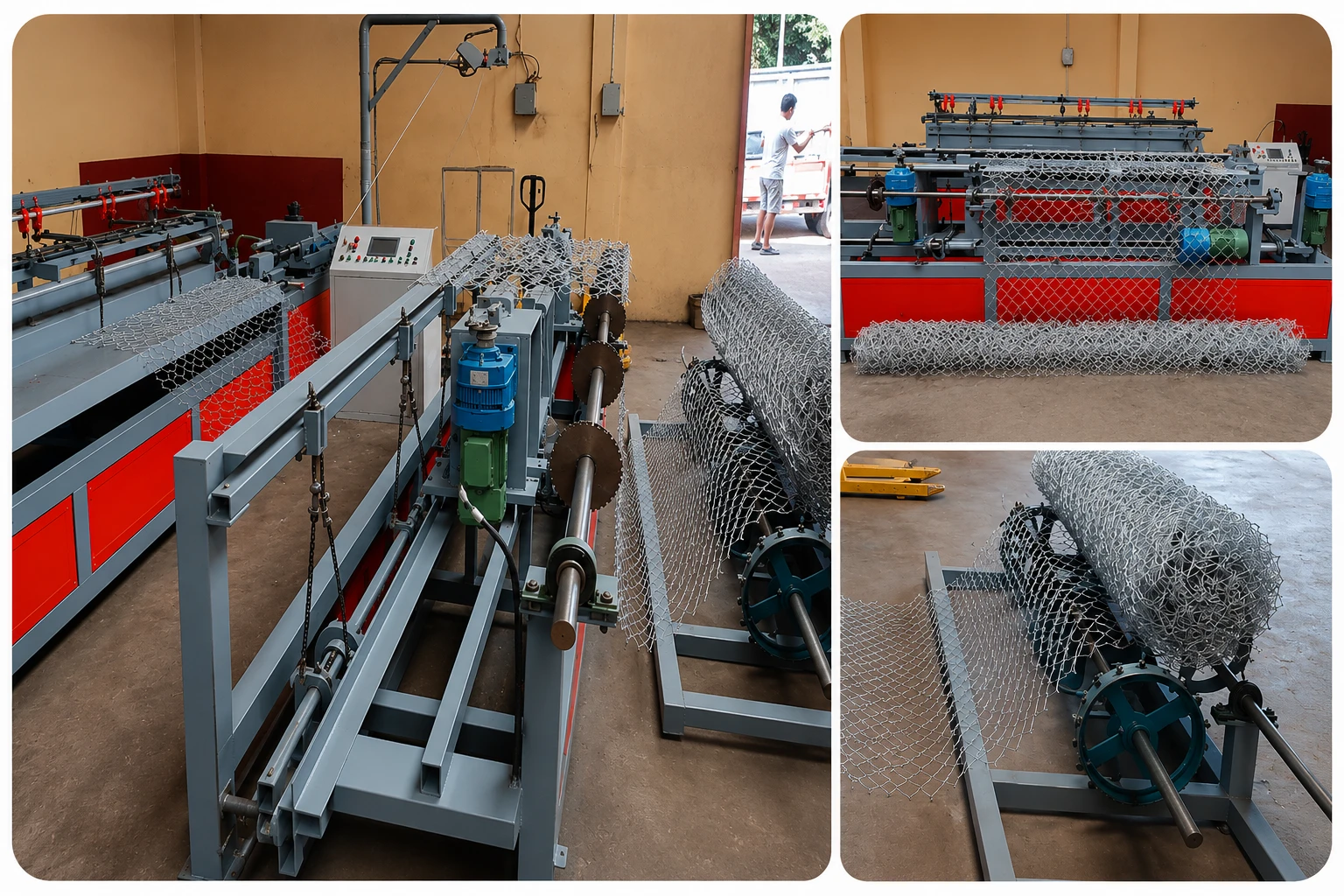
Fully Automatic Single Wire Chain Link Fencing Machine
Premium 2000 RPM Panasonic servo motor system. Delta PLC screen, auto knuckle edge bending, twisting, and mesh roll winding.
Rs. 8,50,000 + 18% GST